

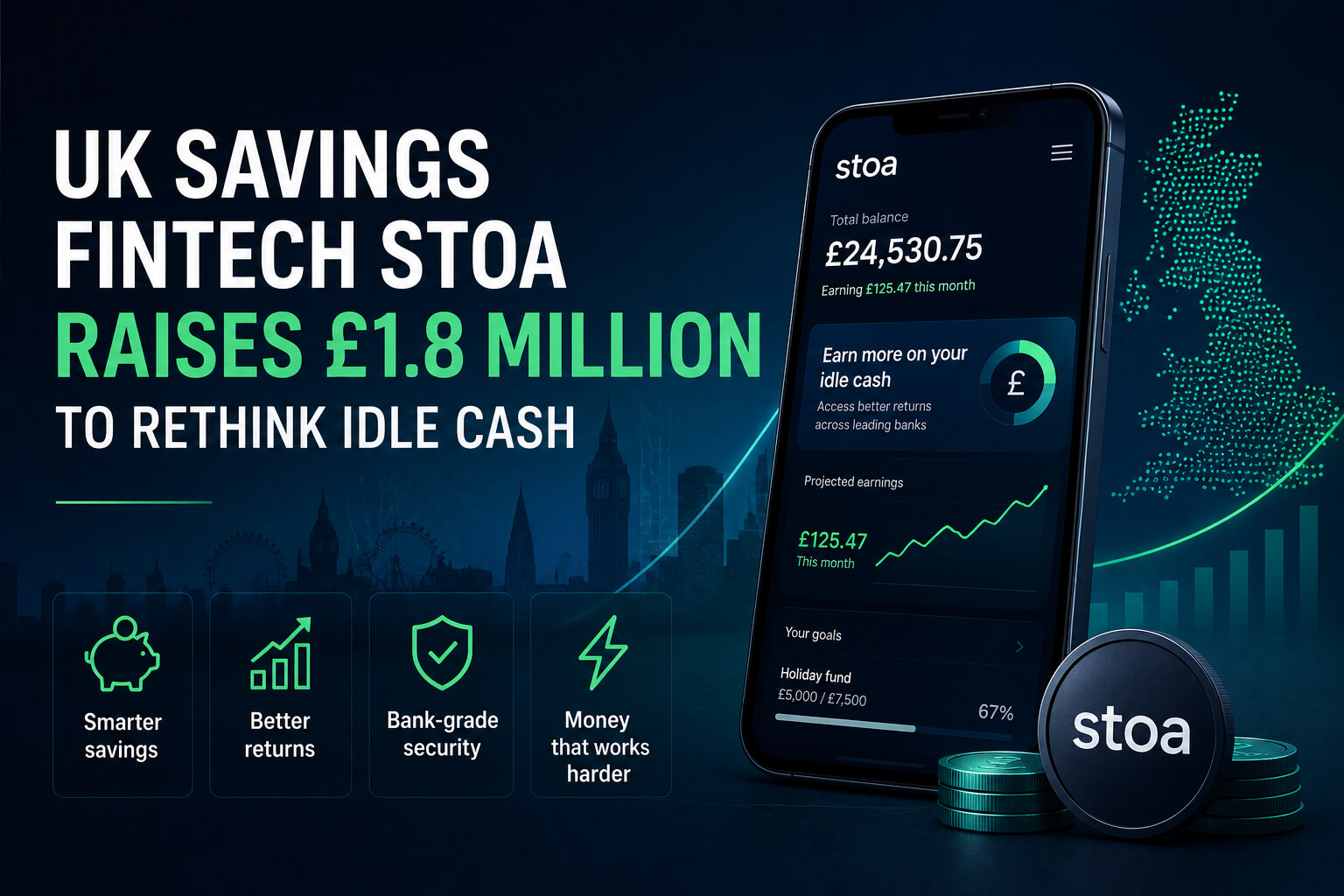
UK savings fintech Stoa has raised £1.8 million in pre-seed funding, giving the startup fresh capital to build what it believes could become a new kind of savings product.
The round was co-led by Bespokeist Partners and Ingenii Capital. Not a huge mega-round, no dramatic unicorn talk, but the idea behind it is interesting: Stoa wants people and businesses to get something more immediate from the money they leave sitting around.
Instead of waiting months for interest to slowly build, Stoa is pushing a different model. Save money, lock it for a fixed term, and receive practical perks upfront from merchant partners.
Stoa Wants Savings to Feel More Useful
Savings products are usually sold around interest rates. Higher rate, longer lock-in, better return. Simple enough, but also not exactly exciting.
Stoa is trying to shift that habit. Its platform encourages consumers and businesses to park idle cash in exchange for tangible benefits they can use straight away. The company calls this approach “save-to-get-perks,” and its deposit technology is known as Stoa Pots.
That could mean savings become less about waiting and more about immediate value. For users, the appeal is obvious. Their money is still being put aside, but the reward does not feel distant or invisible.
For banks and building societies, Stoa’s pitch is also practical. If customers are willing to keep larger deposits locked in for longer periods, financial institutions get a more stable deposit base.
Saving Score Adds Another Layer
Stoa is also developing Saving Score, which it describes as the world’s first score focused on tracking saving behaviour.
That part may become important. Credit scores are everywhere, but saving behaviour has not had the same kind of consumer-facing measurement. Stoa appears to be betting that people may want a clearer view of how well they save, not just how they borrow.
It is a small distinction, but in fintech, these small distinctions often become product categories if enough banks, merchants, and customers decide they care.
Merchant Perks Could Make the Model Stick
The merchant side of the platform is where Stoa’s model gets a little more interesting.
The company says customers will be able to unlock everyday benefits from merchant partners after committing deposits for a fixed term. For merchants, this can potentially create loyalty without leaning so heavily on card-linked offers, discounting, or expensive acquisition campaigns.
Stoa says it is already in advanced discussions with multiple flagship brands, banks, and building societies to distribute Stoa Pots and Saving Score.
That does not mean the model is proven yet. It means the company is trying to sit between banks that want deposits, merchants that want loyalty, and customers who want savings to feel less passive.
Former Starling Bank CEO Joins as Advisor
Stoa has also brought in John Mountain, former CEO and co-founder of Starling Bank, as an advisor.
His role will focus on product innovation and growth across financial institutions and merchant distribution. That kind of advisory support matters for an early-stage fintech trying to work with banks, because distribution in financial services is rarely simple.
A good product is not enough. You need trust, compliance, partnerships, and a reason for established institutions to care.
Why This Funding Matters
The £1.8 million pre-seed raise gives Stoa room to keep building its savings infrastructure and partnership network.
The timing is useful too. Consumers are more aware of interest rates than they were a few years ago, but many savings products still feel cold and transactional. Stoa is trying to make idle cash feel active, useful, and tied to everyday spending benefits.
Whether that becomes a major savings category is still an open question. But the direction is clear enough. Fintech startups are no longer only trying to make payments faster or banking apps cleaner. Some are now trying to redesign the emotional side of saving money.
And Stoa thinks upfront perks may be the hook.