

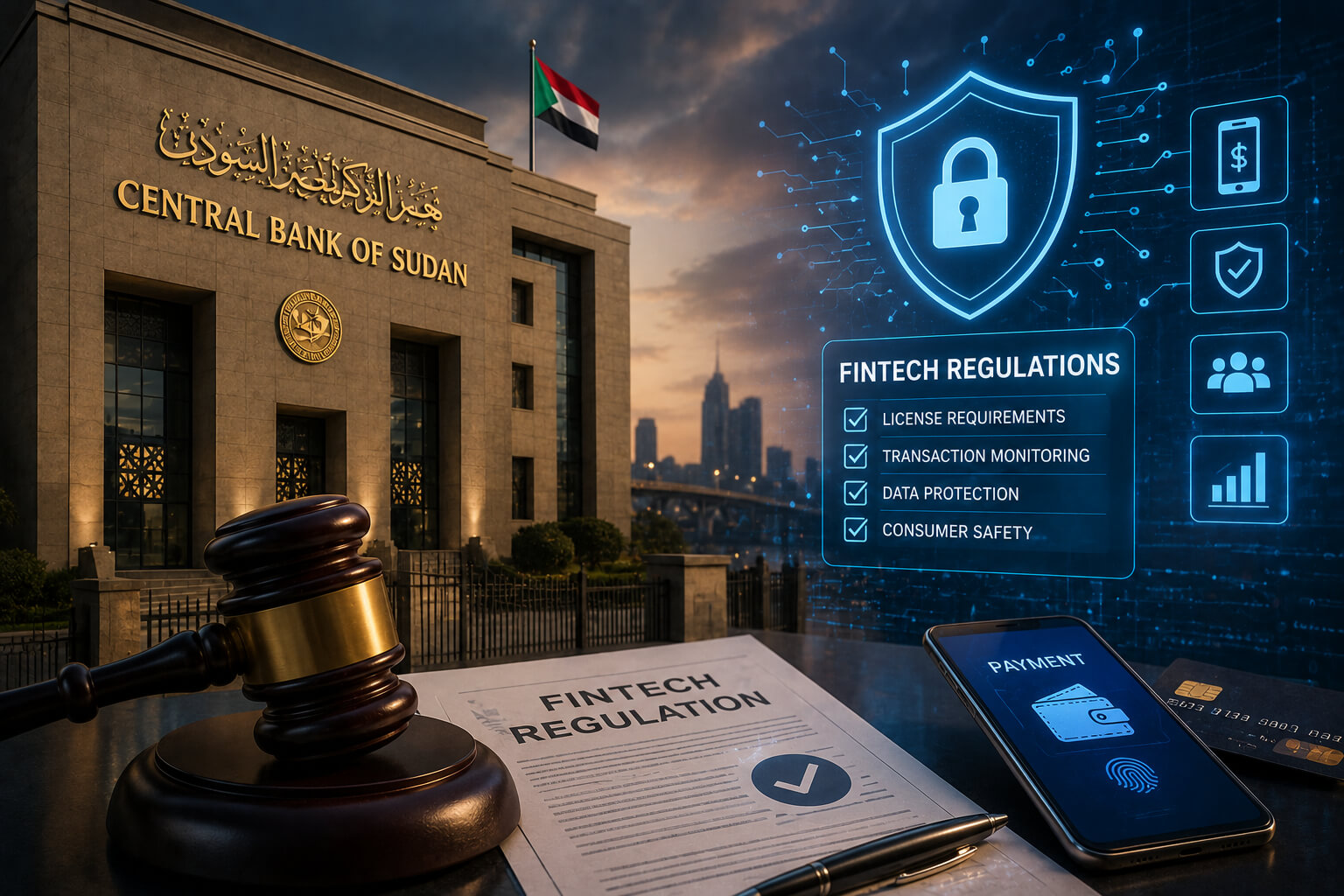
The Central Bank of Sudan has ordered banks and licensed financial technology companies to obtain prior approval before entering into contractual, operational, or technical partnerships. The order also applies to data exchanges, technical integrations, and financial switch operators working inside the country’s payment ecosystem.
It is a regulatory move with a very clear message: Sudan wants fintech growth, but not at the cost of banking stability, customer data, or central bank control.
Central Bank Moves After Al-Asjad Platform Debate
The decision comes after controversy surrounding Al-Asjad for Digital and Smart Solutions and the launch of its new digital financial platform.
The platform attracted attention not only because of its role in Sudan’s digital finance space, but also because of questions raised about the company’s recent establishment, its technical and financial capacity, and reported indirect links to the United Arab Emirates. The launch event itself was high-profile, with officials, banking leaders, and financial experts in attendance.
That kind of visibility can help a fintech company look serious. It can also invite more questions.
And in Sudan’s banking environment, questions around payment infrastructure are not small matters. Digital finance touches bank connectivity, customer information, retail payments, government collections, telecom payments, and direct bank-to-bank transfers. One weak link can become a much bigger problem.
No Partnerships Without Written Approval
Under the new directive, banks and licensed fintech firms cannot move ahead with partnerships or data links without approval from the central bank.
That includes technical relationships, operational arrangements, and any exchange of financial or customer data. The rule also covers companies licensed as financial switch operators, which play a major role in connecting banks, payment platforms, ATMs, point-of-sale systems, and other digital financial services.
The central bank made it clear that a license alone does not give any company an automatic right to provide services to banks. Every integration still needs separate approval.
This is where the policy becomes more than paperwork. Sudan is separating permission to operate from permission to connect directly with the banking system.
Customer Data Is the Bigger Issue
The central bank said customer data protection and financial confidentiality remain top priorities.
Licensed entities are expected to follow strict standards covering encryption, data governance, access control, cybersecurity, risk management, financial solvency, corporate governance, and business continuity.
That list may sound technical, but the point is simple. Fintech firms are no longer just app builders. In payment systems, they can become gateways into sensitive banking infrastructure.
For Sudan, that means fintech partnerships now need to be treated as national financial infrastructure decisions, not just commercial deals between companies.
Sudan Still Wants Digital Payments to Grow
This is not a rejection of fintech.
The central bank said licensing multiple entities is part of a modern regulatory approach designed to increase competition, improve efficiency, support innovation, and reduce operational risks.
Several national companies have recently received licenses to operate as financial switch operators, including Bright Technologies, Al-Asjad for Digital and Smart Solutions, Nahda Technology, and Sudapost.
These companies are expected to help banks that do not have their own switch infrastructure. That could allow more institutions to offer card services, retail banking products, ATM connectivity, point-of-sale payments, and other digital financial services.
So the direction is still digital. Just more controlled.
Payment Infrastructure Is Becoming Strategic
Sudan’s payment system is no longer only about banks processing transactions.
The central bank’s plan includes connecting telecom companies, electricity providers, government revenue collection agencies, fintech firms, and banks into a wider national payment network. That is a major shift for financial inclusion and public service payments.
But the more connected the system becomes, the more valuable and sensitive it becomes.
That is why the regulator is keeping policy, licensing, supervision, and approval authority firmly under central bank control, while allowing licensed companies to handle technical and operational services under official guidelines.
What This Means for Sudan’s Fintech Sector
For fintech companies in Sudan, the message is not complicated.
Innovation is welcome. Unapproved integrations are not.
Banks will now need to be more careful before signing fintech partnerships. Fintech firms will need stronger documentation, clearer ownership structures, stronger cybersecurity controls, and proof that they can handle sensitive financial data properly.
For customers, the impact may not be immediate. But in the background, this could shape which platforms are allowed to connect to banks, how digital payments expand, and how much trust users place in Sudan’s growing fintech ecosystem.
Sudan’s fintech sector is moving forward. The central bank just made sure it moves under closer watch.