

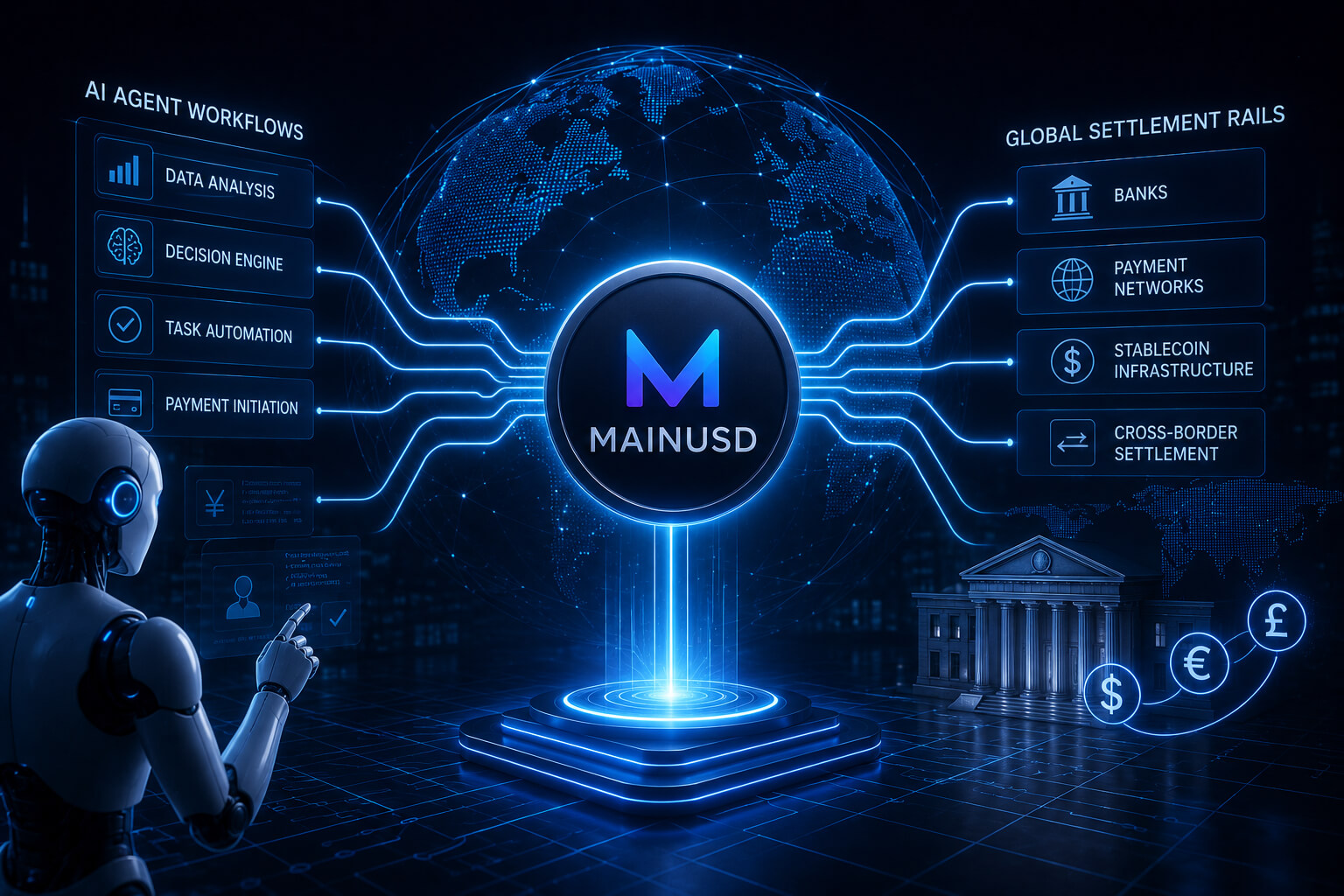
Mosta has launched MainUSD, a new digital dollar built to bring stablecoin settlement into everyday business finance. The launch comes through a partnership with Brale, a U.S.-regulated stablecoin issuance and orchestration provider, giving Mosta’s corporate clients access to a programmable dollar system inside their existing financial workflows.
This is not just another crypto payments feature added onto a dashboard. MainUSD is being positioned as part of a bigger shift in business banking, where companies want faster settlement, cleaner cross-border movement, and fewer awkward gaps between fiat accounts, wallets, payment rails, and corporate spending tools.
The timing also matters. Stablecoins are moving beyond speculative trading and into corporate treasury use cases. According to The Fintech Times, global stablecoin on-chain settlement volume has reached $7.5 trillion, surpassing U.S. ACH transaction volume for the second consecutive month. That is the kind of number that gets banks, fintechs, and enterprise finance teams paying attention.
Why Mosta Is Targeting Cross-Border Settlement
Cross-border payments remain one of the clunkiest parts of global business. Companies still deal with slow bank transfers, disconnected accounts, hidden margins, multiple currencies, and payment systems that do not always talk to each other nicely.
MainUSD is meant to reduce that mess.
Mosta says the asset supports more than 20 public and enterprise blockchains, including Ethereum, Solana, Base, Polygon, and Canton. The idea is simple enough: businesses can receive different digital assets, convert them into one MainUSD balance, and then use that balance for vendor invoices, corporate cards, or international payouts.
That matters because many companies do not want to manage five wallets, three banking portals, and a pile of settlement delays just to operate across markets. They want one financial layer that can move between stablecoins and traditional rails without turning every payment into a small operations project.
Bridging Stablecoins and Traditional Payment Rails
The stronger part of the MainUSD launch is not only the stablecoin side. It is the bridge back into traditional payments.
Mosta users can route liquidity across more than 150 countries using stablecoin rails or traditional clearing systems, including SWIFT, SEPA, bank wires, ACH, and more than 10 localized payment networks. That gives businesses a way to move between blockchain-based settlement and the payment systems they already use.
That bridge is where stablecoin adoption usually gets serious. Speed is useful, yes. But businesses still need invoices, reconciliation, bank access, vendor payments, compliance, and reporting. Without those boring pieces, stablecoins stay interesting but difficult.
MainUSD is trying to make the boring pieces work.
AI Agents Need Payment Rails Too
The more unusual part of this launch is the AI angle.
Mosta is not only building MainUSD for human finance teams. It is also positioning the asset for agentic finance, where autonomous AI agents can handle purchasing, procurement, vendor payments, and other repeatable financial tasks under company-defined rules.
Through MainUSD, companies can issue controlled automated corporate cards to AI agents connected through the Model Context Protocol, or MCP. Those agents can then carry out multi-step business transactions while operating within programmatic controls and human oversight.
That may sound futuristic, but it is not hard to see where this is going. If AI agents are going to book services, pay suppliers, manage software subscriptions, or trigger supply-chain payments, they need financial rails that machines can read and use safely. A normal card flow was not really designed for that world. A programmable settlement layer gets closer.
Compliance Is Still the Hard Part
Stablecoin products live or die on trust. Businesses do not just need fast settlement. They need to know where reserves sit, how accounts are structured, what compliance framework applies, and whether the asset can survive regulatory scrutiny.
Mosta says MainUSD is designed around business-grade security, with named segregated accounts held at Tier-1 partner banking institutions. The product also includes branded invoicing and automated transaction reconciliation, which are exactly the kinds of features finance teams care about once the excitement around faster payments fades.
Brale’s role is also important. By working with Brale, Mosta can rely on regulated issuance, reserve management, and compliance infrastructure instead of building all of that from scratch. The Fintech Times also reported that MainUSD has been structured to comply with the emerging U.S. GENIUS Act payment stablecoin framework as implementation rules take effect.
What MainUSD Means for Enterprise Fintech
MainUSD shows how fintech is starting to merge three big trends: stablecoins, cross-border payments, and AI automation. Usually these stories get treated separately. Here, they are being pushed into the same operating layer.
That is the interesting part.
A business may not care about “Web3” language. It may not even care that much about the chain used underneath. What it does care about is whether money can move faster, whether costs can come down, whether reconciliation is easier, and whether automated systems can act without creating financial chaos.
Mosta is betting that programmable stablecoin rails can become part of that answer.
The Bigger Shift Toward Agentic Finance
The MainUSD launch points to a broader change in business finance. Payments are no longer only moving from bank to bank or wallet to wallet. They are starting to move between people, systems, workflows, and eventually autonomous agents.
That creates a new kind of fintech requirement. Payment infrastructure has to be fast, but also controlled. Programmable, but not reckless. Global, but still compliant. Machine-readable, but still accountable to human teams.
MainUSD is one attempt to solve that gap.
Whether it becomes a major enterprise settlement layer will depend on adoption, regulation, trust, and how quickly companies actually let AI agents touch real payment workflows. But the direction is clear enough. Stablecoins are moving closer to corporate finance, and AI agents are beginning to need money movement tools of their own.
That combination could make agentic finance one of the more important fintech stories to watch.