

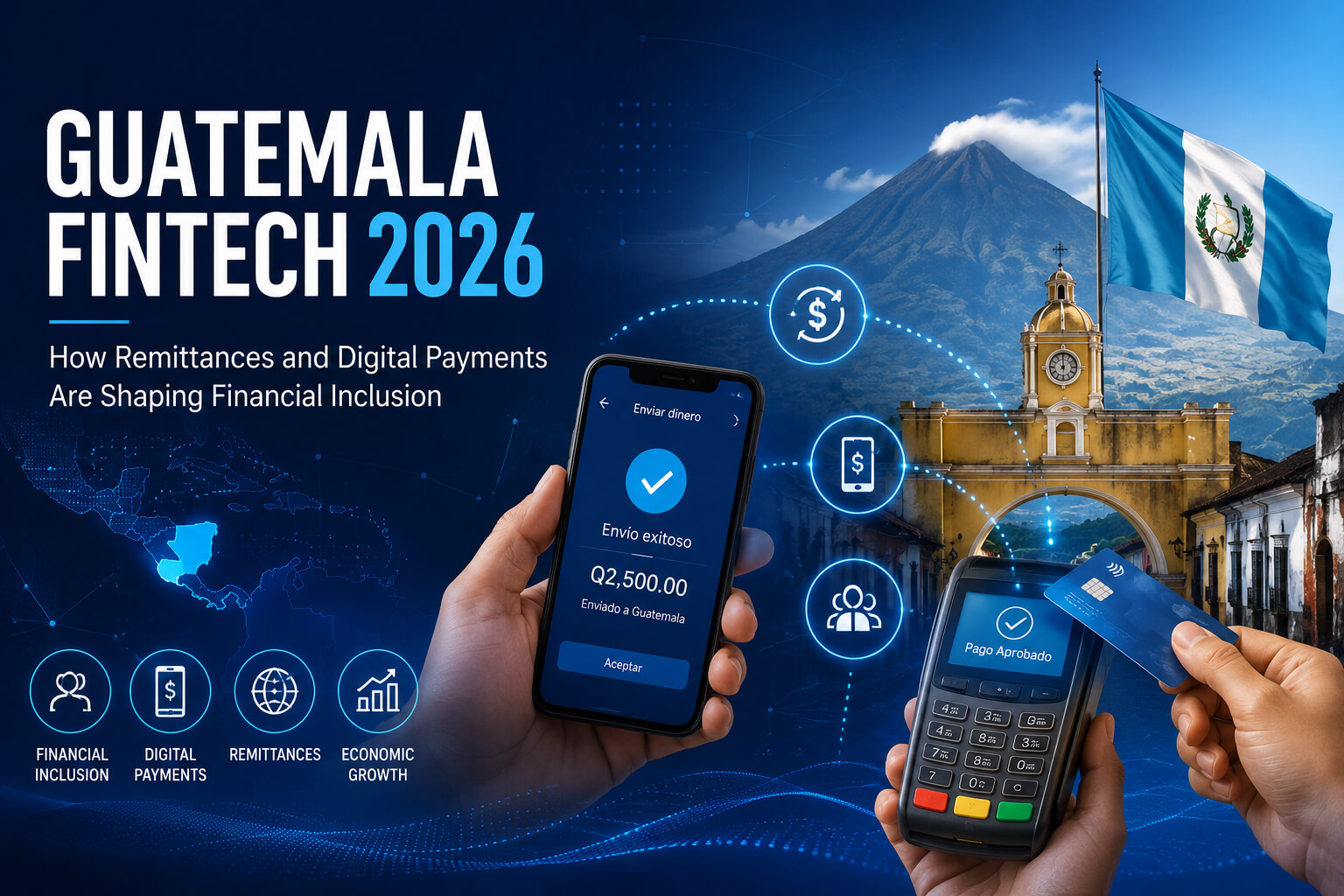
Guatemala is becoming one of Central America’s most important fintech markets in 2026, driven by a combination of strong remittance flows, growing digital payments adoption and rising demand for more inclusive financial services.
Unlike larger Latin American fintech hubs such as Brazil, Mexico and Colombia, Guatemala’s fintech story is not primarily about producing high-profile unicorns. Instead, the country’s biggest opportunity lies in using financial technology to improve everyday financial access for households, small businesses, informal workers and rural communities.
At the center of this transformation is one of Guatemala’s most important economic lifelines: remittances.
Remittances Remain the Foundation of Guatemala’s Fintech Opportunity
Millions of Guatemalan families receive money from relatives working abroad, particularly in the United States. These remittance flows help support daily household spending, education, housing, healthcare and small business activity.
In 2024, family remittances represented nearly a fifth of Guatemala’s GDP, showing just how central cross-border money transfers are to the national economy. This makes Guatemala a unique fintech market. Digital finance in the country is not only about convenience; it is about transforming a major financial flow into a gateway for broader financial participation.
Traditionally, many recipients collected remittances in cash through physical payout locations. While cash remains widely used, digital wallets, mobile transfers and bank-linked payment services are creating new possibilities. If remittance recipients can move from cash collection to digital accounts, those funds can become connected to savings, payments, credit histories and insurance products.
That shift could help bring more Guatemalans into the formal financial system.
Guatemala’s Economy Creates Room for Fintech Growth
Guatemala is Central America’s largest economy, with major activity across agriculture, textiles, manufacturing, food processing, tourism, construction, trade and services. Guatemala City remains the country’s main financial and technology hub, home to major institutions such as Banco Industrial, Banrural, BAC Guatemala and Banco G&T Continental.
However, the country still faces major financial inclusion challenges. High levels of informality, rural development gaps and income inequality mean many people either remain outside the formal banking system or use formal financial services only occasionally.
For fintech companies, this creates both a challenge and a major growth opportunity.
The challenge is clear: many consumers and small merchants still rely heavily on cash. The opportunity is equally clear: digital payments, mobile wallets, credit tools and merchant finance platforms can help make financial services more accessible, useful and affordable.
Digital Payments Are Driving Guatemala Fintech 2026
Digital payments are one of the most important growth areas for Guatemala fintech in 2026. As consumers become more comfortable with mobile banking, e-commerce and online transactions, demand is rising for faster, safer and more convenient payment methods.
Guatemala’s fintech sector has expanded significantly in recent years, growing from only a handful of companies to more than 30 fintech firms. Key areas of opportunity include digital payments, digital credit and corporate finance management.
This growth reflects a broader shift away from cash-only transactions. Banks are improving mobile and online channels, payment processors are helping merchants accept cards and digital payments, and e-commerce is increasing demand for secure checkout solutions.
Mobile wallet services such as Tigo Money are also playing a role by enabling users to make payments, send transfers and top up mobile services from their phones. Traditional banks are also becoming more active in digital finance, showing that Guatemala’s fintech future will likely involve collaboration between banks, payment companies, telecom-linked wallets and regional fintech platforms.
SMEs Could Benefit Most From Digital Finance
Small and medium-sized enterprises are central to Guatemala’s economy. Many merchants, market vendors, rural producers and micro-businesses need easier ways to accept payments, access working capital and manage cash flow.
Digital finance can help solve these problems. For example, when small businesses accept digital payments, they begin creating transaction histories. Those records can help lenders assess risk more accurately and may eventually improve access to credit.
Merchant tools can also support inventory management, bookkeeping and tax compliance. For many small businesses, even basic digital payment acceptance can be a major step toward formalization and growth.
In Guatemala fintech 2026, SME finance is likely to be one of the most important areas to watch.
Agriculture and Rural Communities Are Key to Inclusive Fintech
Guatemala’s economy remains closely connected to agriculture, including coffee, sugar, bananas, cardamom and other exports. Rural producers often face difficulties accessing credit, insurance and efficient payment channels.
Fintech could help connect farmers with buyers, streamline payments across agricultural value chains and support new tools for climate and risk management. However, these solutions must be designed around local realities.
Guatemala has a large indigenous population, and many rural communities face barriers related to language, geography, education and internet access. For fintech to be truly inclusive, mobile-first tools, agent networks, simple interfaces and financial education will be essential.
Technology alone will not solve financial exclusion. Trust, affordability and accessibility will determine whether digital finance can reach communities that have historically been underserved.
Regulation and Trust Will Shape the Next Stage
As Guatemala’s fintech ecosystem grows, regulation will become increasingly important. Digital wallets, payment platforms and online financial services require clear rules around licensing, consumer protection, anti-money laundering compliance, data privacy and settlement systems.
Banco de Guatemala, the country’s central bank, will play a central role in supporting financial stability and payment system modernization. As digital transactions increase, regulators and financial institutions will need to ensure that innovation develops safely.
Cybersecurity is another critical issue. New users entering digital finance may be discouraged by fraud, scams or poor dispute resolution. Building trust will require strong consumer protection, reliable platforms and better digital literacy.
What Comes Next for Guatemala Fintech?
Guatemala has several advantages that could support fintech growth in 2026 and beyond. It has a large domestic market by Central American standards, strong remittance inflows, established commercial banks, a growing fintech ecosystem and increasing demand for digital payments.
Still, barriers remain. Cash dependency, uneven internet access, limited financial literacy and infrastructure gaps could slow adoption. Fintech firms may also face challenges raising capital and scaling services beyond urban users.
Despite these obstacles, Guatemala’s fintech opportunity is significant. The country’s next phase of digital finance will likely focus on four major areas: remittances, merchant payments, SME finance and financial inclusion.
If fintech companies, banks, regulators and telecom providers can work together, Guatemala could turn its most important financial flows into tools for broader economic participation.
In 2026, Guatemala fintech is not just about modernization. It is about connection — connecting remittance recipients to formal finance, small businesses to digital payments, rural communities to accessible services and a cash-heavy economy to a more inclusive digital future.