

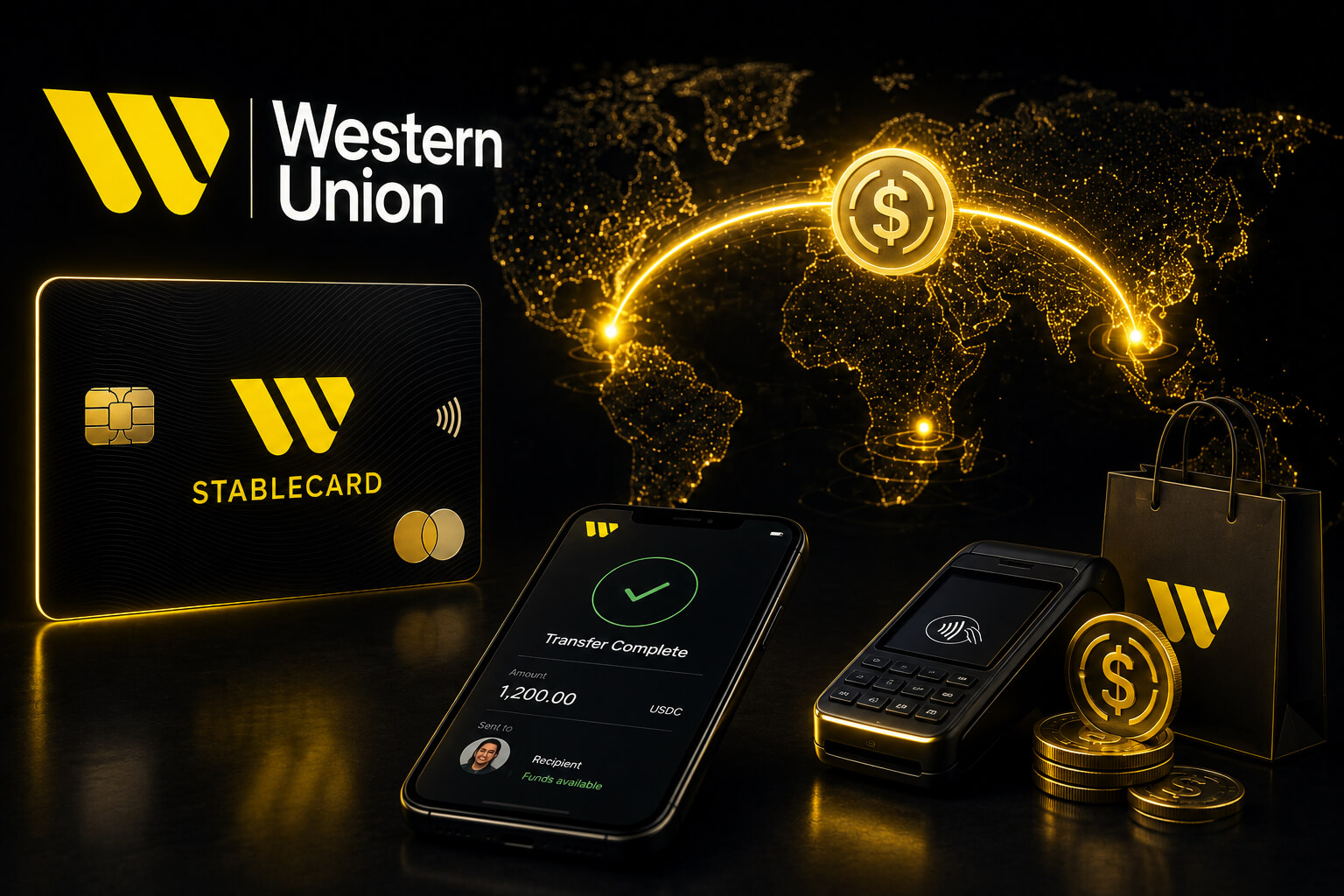
Western Union is pushing its stablecoin strategy beyond transfers and into everyday spending.
The global money-transfer company has launched Stablecard, a new mobile wallet and Visa card product that allows users to receive remittances in USDPT, hold the digital currency and spend the balance without first transferring it to a traditional bank account.
Stablecard is initially being introduced across 37 markets. Western Union plans to expand the product to more than 60 markets before the end of 2026.
Western Union Stablecard Connects Remittances to a Visa Card
Stablecard combines a digital USDPT wallet with a Visa secured credit card inside one mobile application.
A user receiving money through Western Union can choose to have the funds delivered directly to the USDPT wallet. That balance can then be held, transferred to another compatible digital asset wallet or spent through the linked Visa card.
The card works for online and in-store purchases wherever it is supported. Customers can also use it at compatible ATMs and add it to Apple Pay or Google Pay in participating markets.
This removes one of the more awkward steps associated with stablecoin payments. The recipient does not necessarily need to understand blockchain transfers, exchange accounts or wallet conversions before using the money.
The stablecoin sits underneath the experience. The card does the familiar work at the checkout.
USDPT Becomes a Consumer-Facing Payment Product
USDPT is Western Union’s US dollar-denominated stablecoin. It is issued by Anchorage Digital Bank and operates on the Solana blockchain.
The stablecoin is designed to maintain a one-to-one value with the US dollar. Western Union says it is backed by reserves consisting of US dollar deposits, Treasury bills and similar cash-equivalent assets. Anchorage Digital also publishes information relating to USDPT reserve attestations.
Western Union officially launched USDPT in May 2026 as part of a wider effort to modernise its cross-border payment infrastructure.
Stablecard gives the token a more visible role. Rather than functioning only as a settlement asset somewhere behind a transfer, USDPT can now appear in a customer’s wallet and be used for regular purchases.
That distinction matters. Plenty of companies have announced stablecoin experiments. Fewer have connected a proprietary stablecoin to an existing remittance network, a consumer wallet and a globally recognised card network.
Rain Provides the Stablecoin Payment Infrastructure
Western Union developed Stablecard with Rain, a financial technology company specialising in stablecoin-powered cards, wallets and payment infrastructure.
Rain provides the technology supporting both the wallet and card components of the product. Its infrastructure handles the on-chain side of the transaction while presenting users with something closer to a standard mobile banking and card experience.
According to Rain, remittances can arrive as USDPT inside the Stablecard app and become available for spending through the connected card. The platform also supplies compliance and payment controls intended to keep the blockchain mechanics largely out of sight for the user.
That may be one of the product’s stronger selling points.
A remittance recipient does not have to become a crypto trader. They receive dollar-backed value, see the balance inside an app and spend it using a card they already understand.
A Dollar-Based Option for Volatile Currency Markets
Western Union is positioning Stablecard partly as an alternative for customers living in markets where local currencies can lose value quickly.
Instead of immediately converting an incoming transfer into a fluctuating local currency, eligible recipients can hold the funds in USDPT. They can decide later whether to transfer, spend or withdraw the balance.
The practical appeal is not difficult to see. Families often receive remittances to cover food, rent, education and other routine expenses. Holding the transfer in a dollar-backed asset could provide more flexibility between the moment the money arrives and the moment it is spent.
There are still boundaries. Stablecard availability, digital wallet transfers, mobile payment support and ATM access will depend on the customer’s market. Users will also need to consider local regulations, fees and card terms.
Still, this is not a small crypto feature tucked inside an experimental app. Western Union already operates a large international remittance network. Plugging stablecoin spending directly into that network gives the product immediate reach that many standalone digital asset wallets do not have.
Stablecoins Move Closer to Ordinary Payments
Western Union’s Stablecard launch reflects a broader change in the stablecoin market.
The early argument for stablecoins centred heavily on crypto trading. The more recent pitch is simpler: moving dollar-denominated value across borders without relying entirely on conventional banking hours and settlement chains.
Stablecard brings that idea closer to the consumer.
Money can be sent through Western Union, received as USDPT and spent using Visa. The recipient may never need to think about Solana, token transfers or on-chain settlement.
That is probably the point.
Stablecoins will not become mainstream because everyone suddenly wants to learn how blockchain infrastructure works. They become useful when the infrastructure quietly disappears behind an app, a wallet and a card.
Western Union appears to be betting that remittances will be one of the places where that shift happens first.
Sources
- Western Union — Western Union Launches Stablecard in Partnership with Rain
- Fintech News Singapore — Western Union Links Remittances, Stablecoin Spending With Stablecard
- Rain — Western Union’s Stablecard Goes Live on Rain
- Western Union — USDPT Stablecoin and Digital Assets
- Anchorage Digital — Western Union Launches USDPT
- Anchorage Digital — USDPT Reserve Attestations