

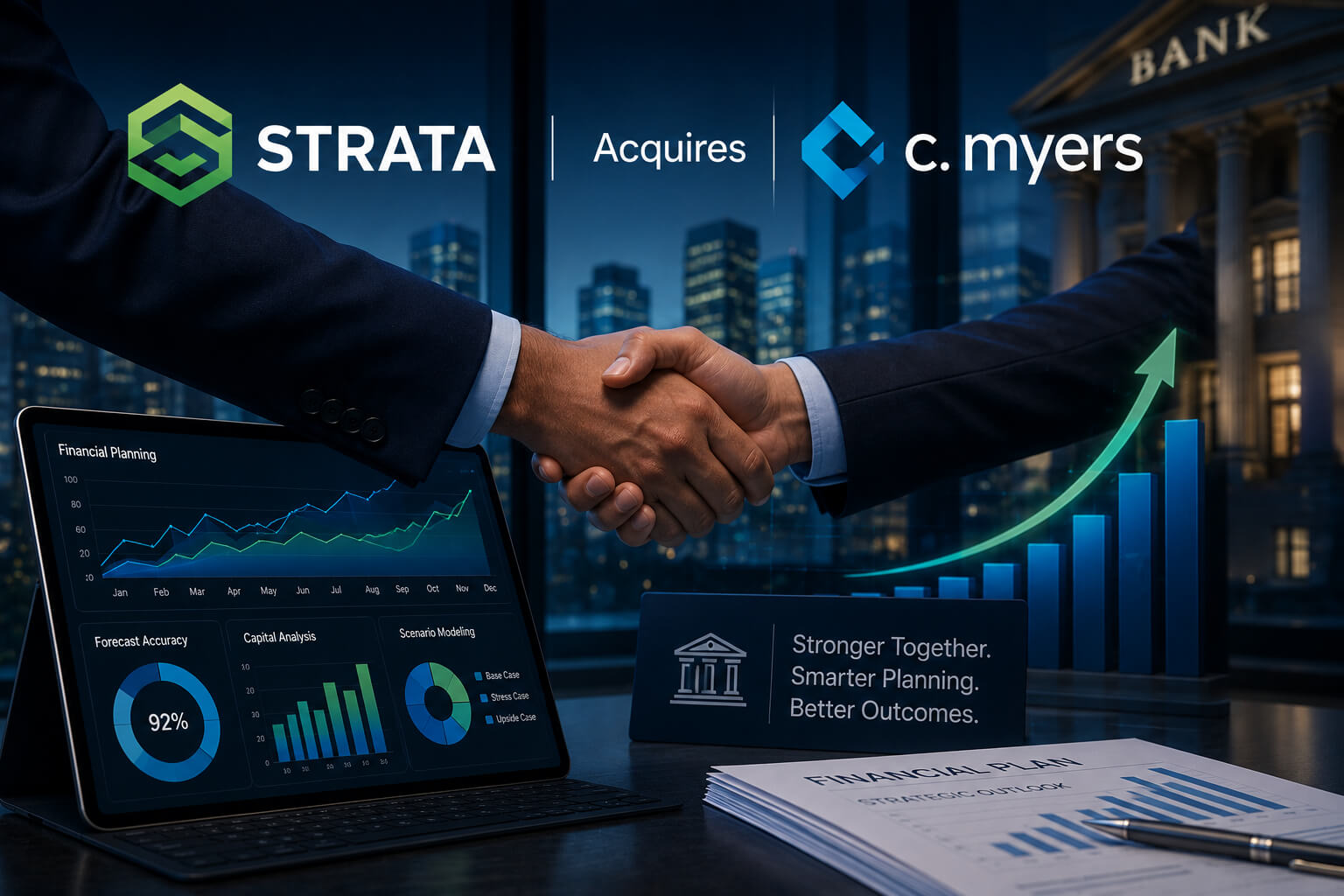
Strata Decision Technology is buying deeper expertise, not just another software feature.
The company has acquired c. myers, a financial services advisory firm known for working with banks and credit unions on strategy, asset-liability management, leadership planning, and financial decision-making.
It is a quiet kind of fintech deal. No flashy consumer app. No crypto angle. No instant-payments drama.
But for financial institutions trying to manage interest rate pressure, profitability, liquidity, board expectations, and long-term planning, this kind of acquisition matters.
Strata Acquires c. myers to Connect Planning and Advisory Work
Strata said the acquisition brings c. myers into its business as part of a broader push to support financial institutions with more connected planning.
The deal combines c. myers’ advisory experience with Strata’s Axiom platform, which is used for financial planning, reporting, profitability, and enterprise performance management.
That is the core idea here: strategy, ALM, FP&A, and reporting should not live in separate corners of the business.
Financial institutions already know the problem. One team works on liquidity. Another builds forecasts. Finance teams prepare board reports. Executives want scenario planning. Then everyone tries to stitch the story together before a major decision.
Strata wants that process to feel less broken.
c. myers Brings Decades of Financial Institution Experience
c. myers is not a new firm trying to ride the banking technology wave.
The company has worked with more than 600 financial institutions over more than 30 years, according to Strata’s announcement. Its work spans asset-liability management, strategic planning, leadership development, succession planning, and executive advisory services.
That history is probably the real asset in this deal.
Software can show numbers. Advisory teams help institutions understand what those numbers mean when the operating environment starts getting uncomfortable.
And right now, uncomfortable is a fair word.
Banks and credit unions are still dealing with a messy mix of rate uncertainty, deposit pressure, margin management, regulatory expectations, and member or customer behavior that does not always follow the old models.
Why ALM Is Becoming More Important Again
Asset-liability management does not usually get much attention outside banking circles.
It should.
ALM sits close to the heart of how financial institutions manage risk. It helps them understand how interest rates, deposits, loans, liquidity, and balance sheet decisions affect the business over time.
When rates move fast, ALM becomes even more important. When deposits become less predictable, it matters again. When boards ask what happens under a downside scenario, someone needs to answer with more than a spreadsheet guess.
That is where the Strata and c. myers combination starts to make sense.
Strata gets more advisory depth. c. myers gets a larger technology platform behind its planning and analytical work.
Adam Johnson and the c. myers Team Join Strata
As part of the acquisition, c. myers CEO Adam Johnson and the company’s team will join Strata.
That detail matters because advisory acquisitions can easily lose value if the people do not stay. In this case, Strata is positioning the deal as a combination of teams, not just the purchase of a client list or methodology.
Strata CEO John Martino said the acquisition will help financial institutions make more confident decisions in a complex environment. Johnson also framed the combination around helping institutions connect strategy, financial insight, and execution.
Corporate language, yes. But the practical meaning is simple enough.
Financial leaders want better visibility before they make big decisions.
Financial Institutions Want More Than Reporting
This acquisition also points to a bigger shift in fintech for banks and credit unions.
Reporting alone is no longer enough.
Executives do not just want to know what happened last quarter. They want to know what could happen next quarter, what the balance sheet looks like under pressure, where profitability is changing, and whether the institution has the leadership bench to handle the next phase.
That is why planning platforms are becoming more valuable.
The best systems are not just dashboards. They connect assumptions, forecasts, scenarios, operational plans, and executive decisions.
Strata clearly wants Axiom to sit closer to that center of decision-making.
A Practical Deal, Not a Loud One
This is not the kind of fintech acquisition that grabs mass attention.
Still, it fits the moment.
Financial institutions are under pressure to plan better, move faster, and explain decisions with cleaner data. Boards want stronger answers. CFOs want fewer disconnected tools. CEOs want strategy that does not fall apart once conditions shift.
Strata’s acquisition of c. myers gives it more credibility in that space.
Not because it suddenly changes banking overnight. It will not.
But it adds advisory weight to a platform already focused on financial planning and performance management. For banks and credit unions, that combination may be more useful than another standalone tool promising easy transformation.
Sometimes fintech moves forward through pipes, planning models, and boardroom decisions.
This is one of those deals.
Sources
- FinTech Futures – Strata acquires financial services advisory firm C Myers
- Strata Decision Technology – Strata Decision Technology Acquires c. myers
- Finextra – Strata Decision Technology acquires c. myers
- The Manila Times – Strata Decision Technology Acquires c. myers