
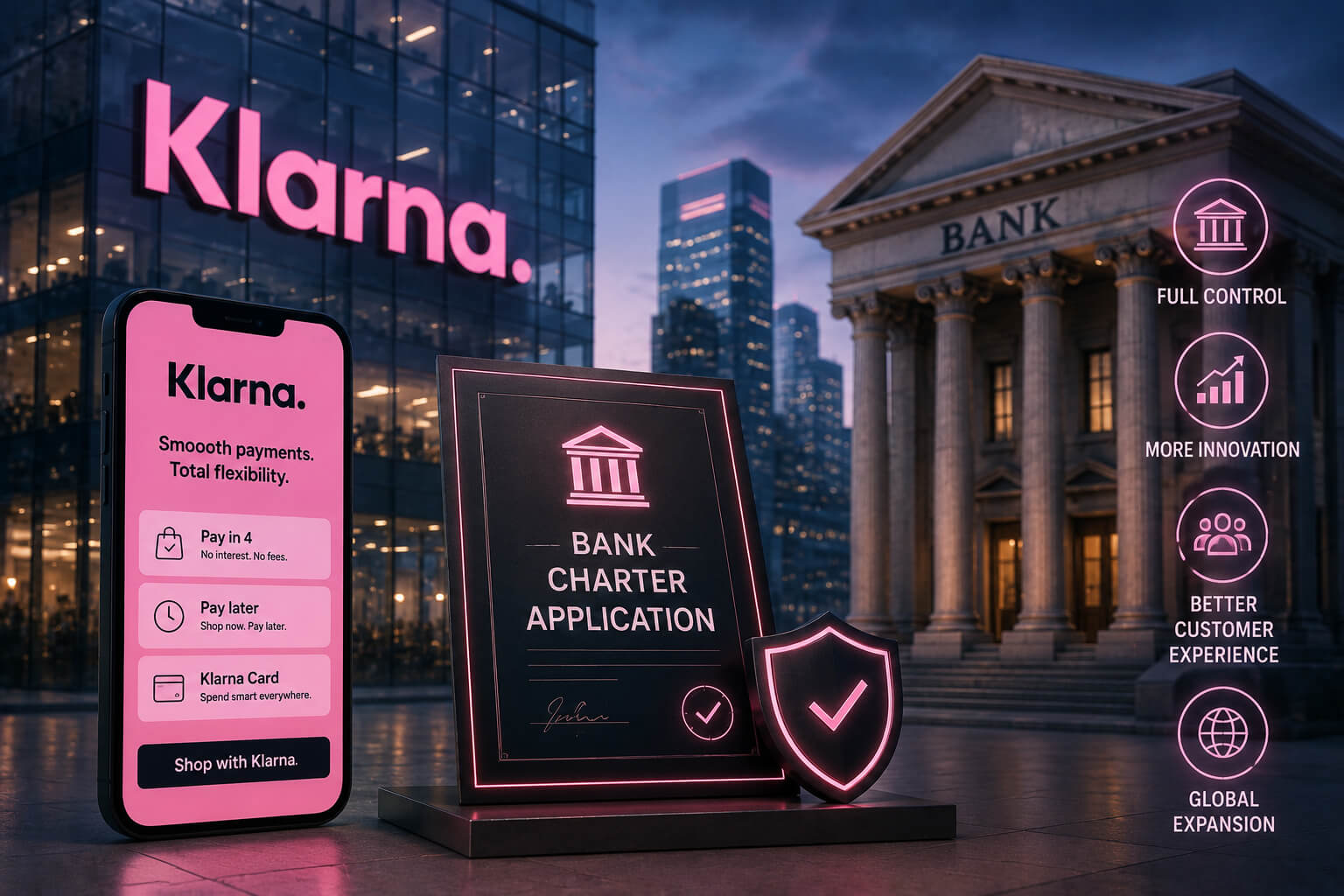
Klarna is no longer just trying to sit beside the banking system. It wants a bigger seat inside it.
The Swedish fintech has applied to establish Klarna Bank USA, a Utah-chartered industrial bank, in a move that could change how the company operates in the United States. The application was filed with both the Utah Department of Financial Institutions and the Federal Deposit Insurance Corp., with Klarna seeking authority to run a federally insured industrial bank.
That sounds technical. It is. But the bigger story is easier to understand.
Klarna wants more direct control over the banking functions that currently depend on partner banks. Deposits. Funding. Payments. Lending. Merchant services. The boring infrastructure behind fintech products is suddenly the part everyone wants to own.
Klarna Wants to Bring More Banking In-House
For years, many fintech companies built slick consumer experiences while banks handled the regulated plumbing underneath. That model worked. It helped companies move fast without becoming full banks themselves.
But it also created limits.
Klarna said the proposed US bank would allow it to internalize banking functions now handled through partners and support payments, savings, lending, and merchant services. Klarna already operates as a licensed bank in Europe, but its US banking activity still relies heavily on partner institutions.
That is the tension at the center of this move.
Partner banks give fintechs access. A charter gives them control.
Not total freedom, though. That part matters.
Industrial Bank Charter Comes With Power and Pressure
Klarna is applying for an industrial bank charter, also known as an industrial loan company charter. This type of charter can let a company accept insured deposits, make loans, participate in the payments system, and issue payment products, while avoiding some of the bank holding company requirements that apply to traditional bank owners.
It is attractive for a reason.
A fintech with this kind of charter can potentially fund lending through insured deposits instead of depending only on warehouse facilities, bank partners, or capital markets. It can also build products with fewer handoffs across outside institutions.
But there is a trade-off.
Industrial banks still face FDIC oversight, capital requirements, consumer protection rules, anti-money laundering obligations, Community Reinvestment Act requirements, examinations, reporting, and long-term supervision.
So Klarna may gain more control, but it also invites much more scrutiny.
That is the price of becoming more bank-like.
This Is Bigger Than Buy Now, Pay Later
Klarna built its global name around buy now, pay later. But the company has been moving beyond that narrow label for some time.
A US banking charter could help Klarna combine savings, payments, lending, deposits, and merchant tools under one regulated structure. That would make it less dependent on outside banks and potentially give the company more room to expand its financial services products.
This also gives Klarna a more stable funding story. According to the company’s latest earnings reference cited by PYMNTS, consumer deposits represented more than 90% of Klarna’s total funding.
That detail is important. Klarna is not only chasing a regulatory badge. It is trying to shape how its business is funded and operated.
Fintechs Are Treating Bank Licenses Like Infrastructure
Klarna is not the only fintech looking at banking licenses this way.
Square Financial Services, now part of Block, received approval for a Utah industrial bank in 2020. Nelnet Bank also received approval in 2020. Thrivent Bank received FDIC approval in 2024 and began operations in 2025 as an online bank. GM Financial also secured approval after revising and refiling its application.
That history shows something practical. These approvals can happen, but they are not casual.
Regulators examine capital, management, governance, liquidity, cybersecurity, compliance systems, risk controls, business plans, and long-term financial viability. For a fintech, this is not just paperwork. It is a commitment to operate under the expectations of the banking system.
And that is exactly why Klarna’s application is worth watching.
The Fintech Banking Model Is Changing
The old fintech playbook was simple enough: build the app, partner with banks, scale fast, keep the front-end relationship with the customer.
Now the model is shifting.
Large fintechs increasingly want to own more of the stack. Not because partner banks are disappearing. They are still useful. But relying on them can create constraints around economics, product design, speed, compliance, and strategy.
Klarna’s charter bid suggests that some fintechs now see banking licenses as strategic infrastructure. Not a trophy. Not just a trust signal. Infrastructure.
The risk is obvious. More regulation. More examinations. Less flexibility.
The reward is also obvious. More control.
Klarna is making the bet that the reward is worth it.