

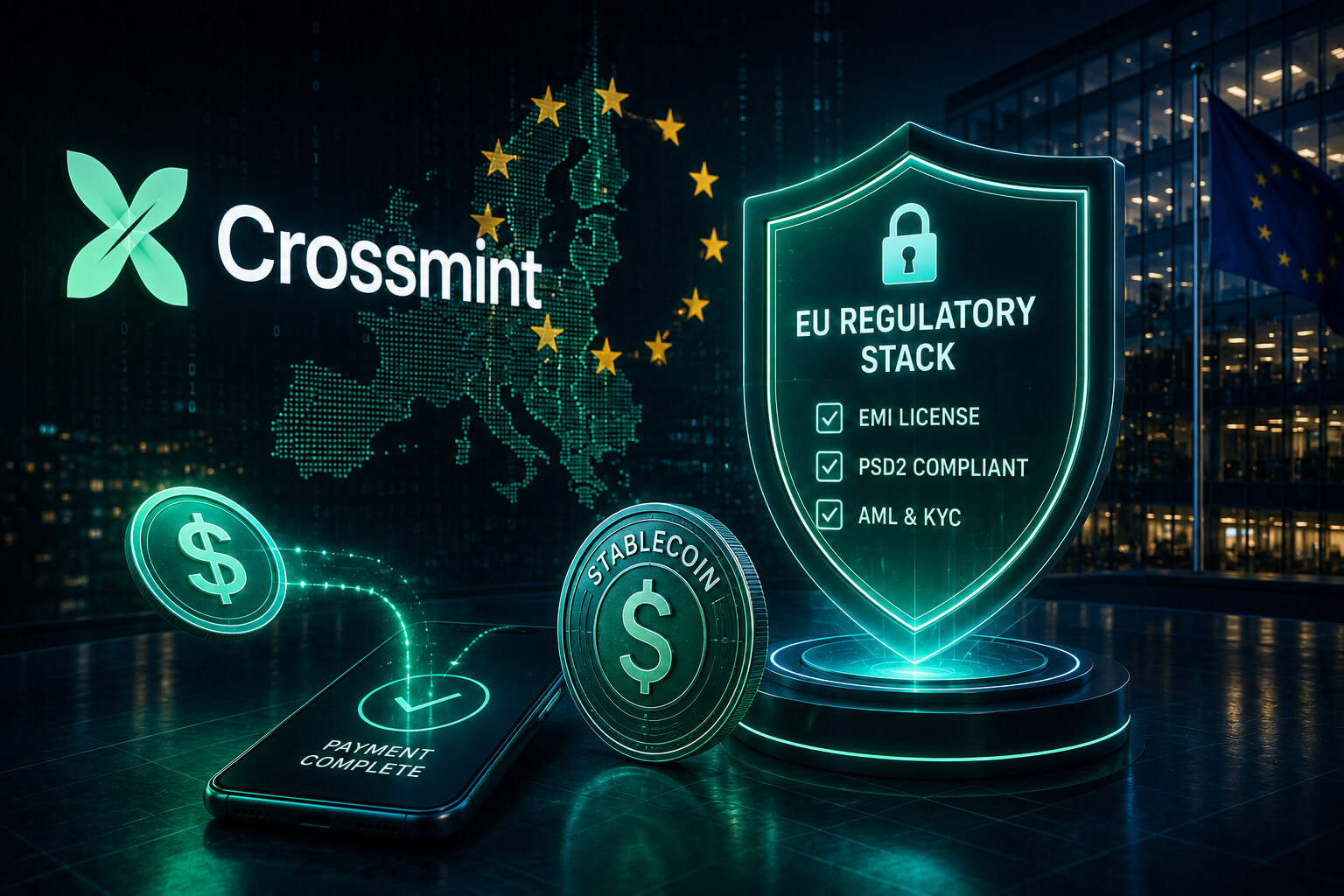
Crossmint has taken a bigger step into regulated stablecoin infrastructure in Europe after securing Payment Institution authorization under PSD2 and completing its MiCA registration as a crypto-asset service provider.
That sounds technical. It is. But for fintech companies, neobanks, remittance platforms, and payroll providers trying to use stablecoins without stitching together several vendors, this is the part that matters: Crossmint can now support both holding stablecoins and moving them as payments under two of the European Union’s main regulatory frameworks.
Not just a crypto license. Not just a payments license. Both.
Crossmint Moves Deeper Into Regulated Stablecoin Infrastructure
The company was authorized as a Payment Institution by the Bank of Spain under the EU’s Payment Services Directive, known as PSD2. Earlier in 2026, Crossmint also received MiCA class 2 authorization from Spain’s CNMV, allowing it to operate as a crypto-asset service provider across the European Union.
With the required conditions now completed, Crossmint has been fully registered as a CASP with CNMV. That means it can passport its services across all 27 EU member states.
For a stablecoin infrastructure provider, this is not a small administrative update. It gives Crossmint a stronger compliance foundation at a time when stablecoins are moving from crypto-native products into more serious payment conversations.
Why PSD2 and MiCA Matter Together
MiCA gives the EU a regulatory framework for crypto-assets. PSD2 governs payment services. Stablecoins sit awkwardly between those worlds because they behave like digital assets, but companies increasingly want to use them like money movement tools.
That gap is where Crossmint is trying to position itself.
With both authorizations, Crossmint says fintechs building on its platform can use one regulated provider for the full flow: stablecoin custody, wallets, transfers, and payment movement. Without this kind of setup, companies may need to rely on multiple licensed partners just to cover different parts of the transaction chain.
That is expensive. It is slow. And honestly, it is exactly the kind of operational headache that makes many fintech teams delay stablecoin projects altogether.
Stablecoins Are Becoming Payment Rails, Not Just Crypto Products
The stablecoin story in Europe is changing. It is no longer only about trading, token swaps, or crypto exchange balances.
The more interesting use cases are quieter: cross-border remittances, payroll, treasury movement, merchant settlement, neobank infrastructure, and embedded financial products. These are not flashy use cases, but they are the ones that can turn stablecoins into actual payment rails.
Crossmint’s latest authorization gives it more room to serve that market.
The company said the combined MiCA and PSD2 framework allows its stablecoin custodial wallets and transfer infrastructure to operate under both crypto-asset and payment-service requirements. PSD2 also brings protections such as strong customer authentication, fraud liability frameworks, and prudential safeguards into the service structure.
That may not sound exciting. For enterprise fintech buyers, it is probably the exciting part.
One Provider Instead of a Patchwork of Vendors
One of the biggest problems in fintech infrastructure is fragmentation. A company wants to launch a financial product, then suddenly needs one vendor for wallets, another for compliance, another for payments, another for on/off-ramps, and another for fraud checks.
Crossmint is trying to reduce that mess.
Its pitch is that stablecoin payments should be easier to deploy through one regulated infrastructure layer. For neobanks, remittance companies, and payroll platforms, that could make stablecoin adoption less experimental and more usable.
The authorization also reduces Crossmint’s dependency on third-party payment processors for certain stablecoin transfer services. That matters because relying on outside licensed providers can add cost, complexity, and delays.
Europe Is Becoming a Serious Stablecoin Test Market
The EU has moved faster than many regions in building crypto regulation through MiCA. Some firms see that as a burden. Others see it as a commercial opening.
Crossmint appears to be in the second camp.
By securing both MiCA and PSD2 authorization, the company is betting that regulated stablecoin infrastructure will become more valuable as European fintechs look for compliant ways to move money faster and across borders.
The race now is not just about who has the best blockchain tools. It is about who can make those tools usable inside the financial system regulators are actually willing to recognize.
That is the harder part. Crossmint just moved closer to it.