

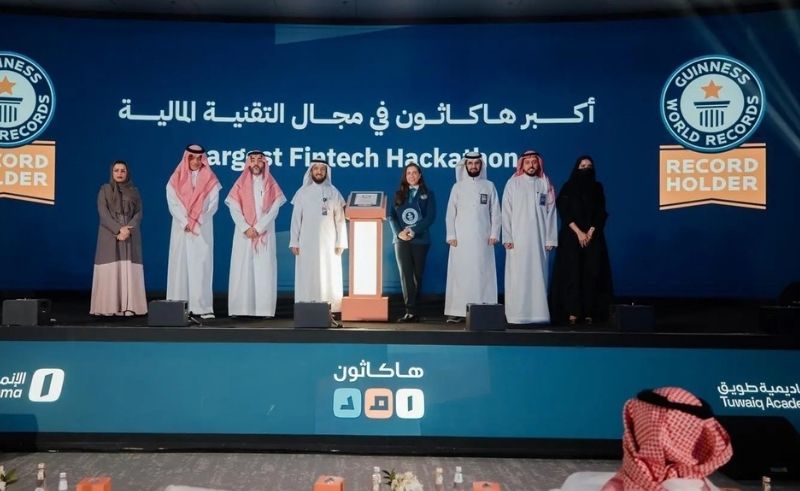
Saudi Arabia has added another record to its fast-growing fintech story.
The second edition of the AMAD Fintech Hackathon has been officially recognized by Guinness World Records as the world’s largest fintech hackathon. The event brought together more than 6,000 participants, both in person and online, with over 2,800 teams joining from across the Kingdom.
That is not a small developer meetup. It is a huge signal.
Saudi Arabia is trying to turn fintech from a policy ambition into something visible, competitive, and crowded with young builders. AMAD gave that ambition a stage.
AMAD Fintech Hackathon Breaks a Global Record
The AMAD Fintech Hackathon was held in Riyadh and organized through a partnership between Tuwaiq Academy and Alinma Bank. The 2026 edition ran for three days, from July 16 to 18, at The Garage in Riyadh, according to the Saudi Press Agency.
The headline number is easy to remember: more than 6,000 participants.
But the more interesting number may be the team count. More than 2,800 teams took part, which shows how broad the participation was. This was not just one large crowd watching a few demos. Thousands of groups were actually competing, building, pitching, testing ideas, and trying to solve fintech problems under pressure.
For a sector that depends on talent, that matters.
Saudi Arabia Is Turning Fintech Into a National Innovation Push
Saudi Arabia has been building its fintech ecosystem for years, but events like AMAD make the effort easier to see.
A hackathon is not the same thing as a licensed fintech company. It does not automatically create the next major digital bank or payments platform. Still, it can reveal where the energy is. Students, developers, founders, product designers, and finance professionals come into one space and start working on practical solutions.
That is the useful part.
The AMAD Fintech Hackathon focused on developing fintech solutions and innovations using emerging technologies across different financial sectors. For Saudi Arabia, this fits into a wider push to grow digital finance, support entrepreneurship, and make the Kingdom more competitive as a regional fintech hub.
Not every idea from a hackathon becomes a company. Most will not. But the talent pipeline gets stronger every time thousands of people are trained to think like builders.
Tuwaiq Academy and Alinma Bank Put Talent at the Center
The partnership behind AMAD also says something.
Tuwaiq Academy has become one of Saudi Arabia’s more visible technology training institutions, while Alinma Bank brings the financial industry side of the equation. Put those together and the message becomes clearer: fintech growth needs both coding skills and real banking knowledge.
That combination is often where fintech gets difficult.
A strong app idea is not enough. Financial products need compliance, trust, security, customer adoption, and a practical use case. A hackathon backed by a bank gives participants a closer view of what the sector actually needs, not just what looks good in a demo.
That is where AMAD becomes more than a record attempt.
The 2026 Record Builds on an Earlier Saudi Hackathon Milestone
This is not Saudi Arabia’s first Guinness-linked hackathon moment.
The first edition of AMAD Hackathon received a Guinness World Record in 2025 as the largest hackathon held in Riyadh. The 2026 edition went further by setting a global record as the largest fintech hackathon in the world.
There is a pattern here. Saudi Arabia is using large-scale competitions not only for publicity, but also to prove that its technology ecosystem can mobilize talent quickly.
Earlier, the Absher Tuwaiq Hackathon also set a Guinness World Record for the largest digital solutions hackathon, with 2,059 participants in Riyadh on December 11, 2025.
Different category. Same direction.
Why This Matters for Saudi Fintech
The record itself is impressive, sure.
But the bigger question is what happens after the certificates, photos, and closing ceremony.
Saudi Arabia’s fintech market is becoming more competitive. Digital payments, open banking, embedded finance, lending platforms, wealth tools, insurance technology, and AI-driven financial services are all areas where local and regional players are trying to move faster.
A hackathon does not solve all of that. It can, however, help create the early-stage ideas and technical confidence needed for a stronger startup pipeline.
The size of AMAD also suggests that fintech is no longer a niche topic in Saudi Arabia. Thousands of people wanted to participate. That kind of turnout gives banks, regulators, investors, and technology companies a deeper pool of young talent to watch.
A Record, But Also a Recruitment Signal
Saudi Arabia’s Guinness World Record should not be read as just a trophy moment.
It is also a recruitment signal. A branding exercise. A skills-development push. Maybe even a quiet message to the wider Gulf fintech market: Saudi Arabia wants to compete for builders, not just capital.
That matters because fintech hubs are not created by announcements alone. They need people who can actually build products, test them, fix them, and eventually turn them into businesses.
AMAD brought thousands of those people into one event.
Now the harder part begins: turning hackathon momentum into real fintech companies, usable financial tools, and long-term industry growth.
Sources
- Saudi Press Agency: https://www.spa.gov.sa/en/N2636818
- Saudi Press Agency: https://www.spa.gov.sa/w2636815
- Riyadh Daily: https://alriyadhdaily.com/article/ae6c2c27cec04b229c412984f013b8f7
- GCC Business News: https://www.gccbusinessnews.com/amad-fintech-hackathon-guinness-record/
- Guinness World Records: https://www.guinnessworldrecords.com/world-records/781107-largest-digital-solutions-hackathon
- CairoScene: https://cairoscene.com/Business/Saudi-Arabia-Sets-Guinness-World-Record-With-Largest-Fintech-Hackathon