

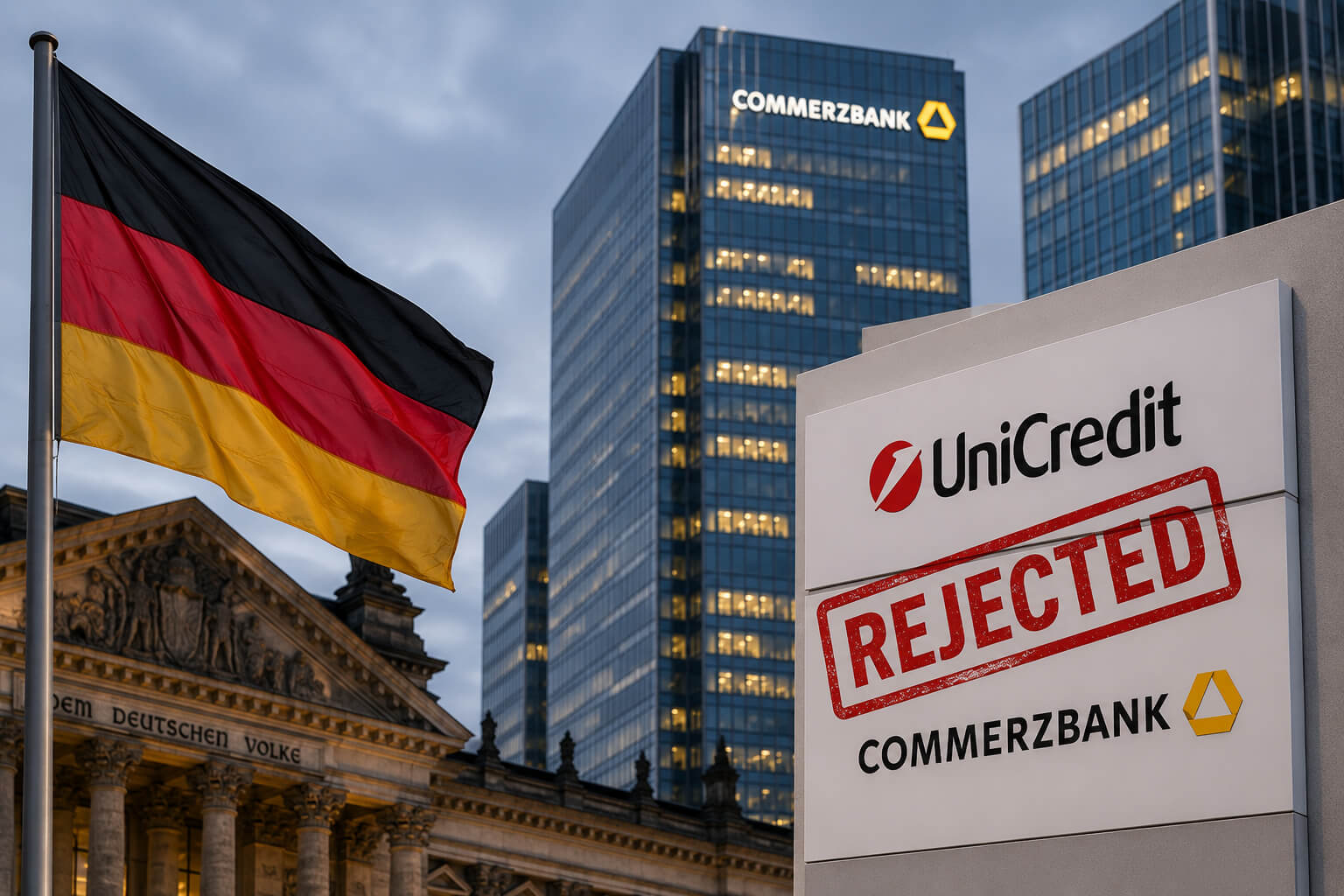
Germany has officially rejected UniCredit’s share-exchange offer for Commerzbank, dealing a major blow to the Italian banking group’s effort to expand its influence over one of Germany’s largest lenders.
The decision was made through the interministerial steering committee of Germany’s Financial Market Stabilisation Fund, which represents the government’s interest as a shareholder in Commerzbank.
According to the German government, accepting UniCredit’s offer was not financially attractive because it did not include a sufficient premium over Commerzbank’s current share price.
UniCredit’s Push for a Larger Commerzbank Stake
UniCredit has been steadily increasing its position in Commerzbank since first acquiring a 9% stake from the German government in September 2024. By early 2026, the Italian lender’s holding had reportedly grown to around 30%.
UniCredit CEO Andrea Orcel had previously outlined ambitions to bring the two banks together, arguing that a merger could create a stronger European banking group.
As part of that strategy, UniCredit submitted a voluntary exchange offer in May 2026. The proposal would have allowed Commerzbank shareholders to swap their shares for UniCredit shares, further increasing UniCredit’s ownership in the German bank.
Details of the Rejected Offer
The offer valued Commerzbank at between €35 billion and €39 billion. Under the proposed terms, shareholders would receive 0.485 UniCredit shares for each Commerzbank share.
However, Commerzbank’s board rejected the proposal, saying the offer did not provide shareholders with an adequate premium. The board also argued that UniCredit had not presented a convincing strategic plan for combining the two banks.
Commerzbank advised shareholders not to accept the exchange offer.
German Government Backs Commerzbank Independence
Germany’s rejection adds further political resistance to UniCredit’s takeover ambitions. The government said it supports Commerzbank’s strategy of remaining independent.
The decision highlights the sensitivity around cross-border banking consolidation in Europe, particularly when national banking champions are involved.
For UniCredit, the rejection is a setback in its attempt to strengthen its position in Germany. For Commerzbank, the decision reinforces its current path as an independent institution.
What This Means for European Banking
The failed offer underlines the challenges European banks face when pursuing large-scale mergers across national borders. While consolidation has long been seen as a way to create stronger financial institutions in Europe, political concerns and shareholder valuation disputes continue to make major banking deals difficult.
UniCredit may still seek ways to increase its influence over Commerzbank, but Germany’s latest decision signals that any future deal will face close scrutiny from both regulators and government stakeholders.
For now, Commerzbank’s independence strategy has received strong backing from its largest public shareholder.