

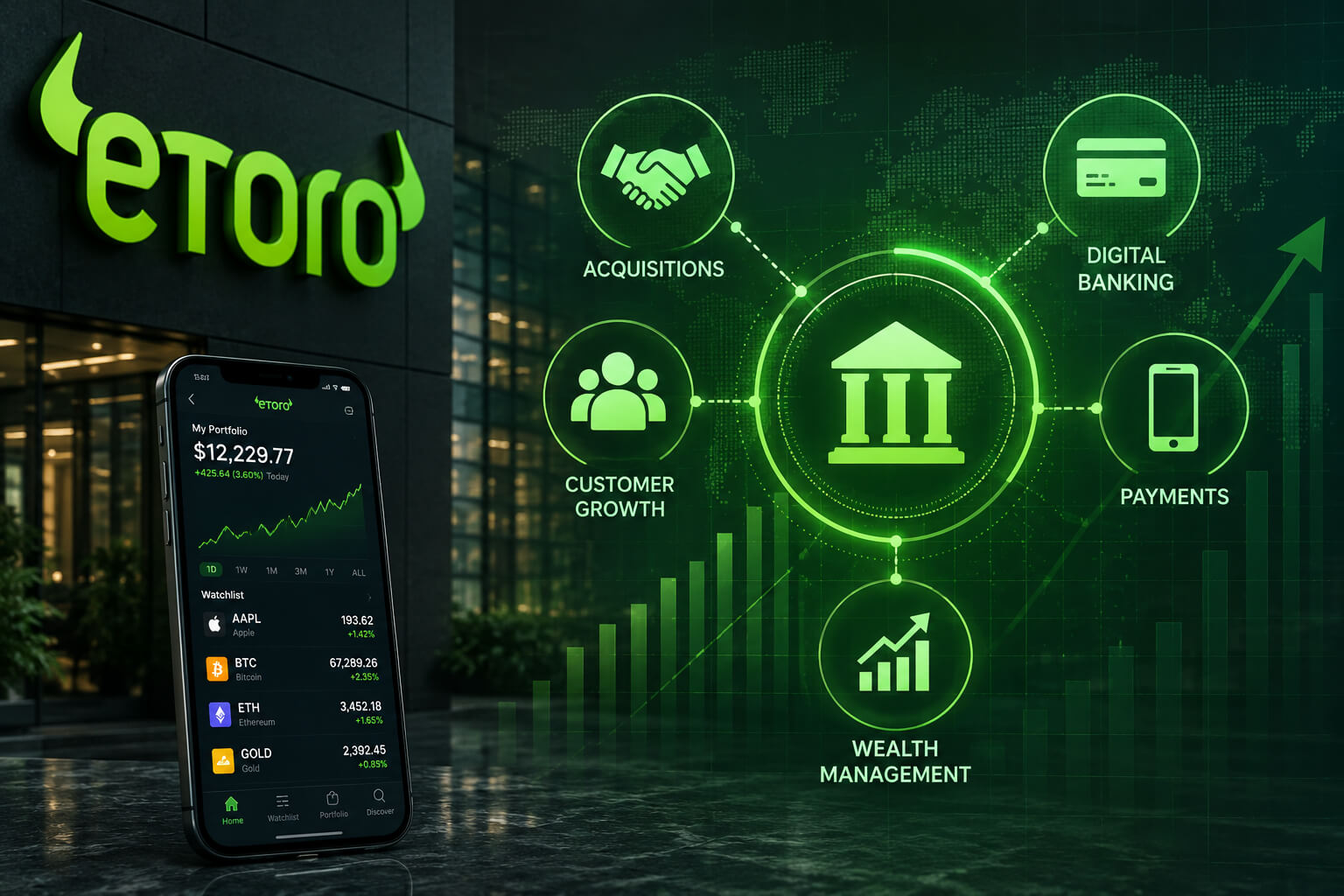
eToro is reportedly preparing for a broader expansion beyond online trading, with the Nasdaq-listed fintech platform exploring acquisitions and traditional banking services as part of its next phase of growth.
The company, best known for its multi-asset trading platform covering stocks, commodities, crypto, and other financial products, is looking at potential deals that could strengthen its wealth-management and payments offerings. The move signals a growing trend across fintech: trading apps and digital investment platforms are no longer relying only on market activity, crypto cycles, or retail investor demand.
Instead, major fintech players are trying to build wider financial ecosystems.
eToro Looks Beyond Trading
According to reports, eToro is working with investment bankers and is considering acquisitions in the wealth-tech space. The company is said to be looking at two potential targets, including one in the United States and another outside the U.S.
This strategy would help eToro expand its global footprint while building more services around long-term investing, wealth management, and financial tools. For a company that has historically benefited from retail trading activity, diversification could make revenue more stable during periods of lower market volatility.
eToro’s business has long been tied to investor interest in assets such as stocks and cryptocurrencies. While those markets can generate strong user activity during bull runs, trading volumes can fall sharply when retail enthusiasm cools. Expanding into banking-adjacent services could help eToro reduce its dependence on trading-driven income.
Payments Could Be the Next Big Opportunity
One of the most important areas of focus appears to be payments. eToro may consider applying for banking licenses or potentially acquiring a bank, though the company’s interest appears to be centered more on payments infrastructure than traditional lending.
That distinction matters. Many fintech companies want the benefits of banking capabilities, such as payment processing, account services, settlement infrastructure, and deeper customer relationships, without necessarily becoming full-scale lenders.
For eToro, payments could create a stronger connection between its trading platform, crypto products, and broader financial services. It could also help the company compete with fintech giants that already offer banking-like features, such as cards, transfers, savings products, and multi-currency accounts.
Zengo Deal Shows eToro’s Acquisition Strategy
eToro has already made a notable move in 2026 with its agreement to acquire crypto wallet provider Zengo. The acquisition is designed to expand eToro’s self-custody crypto capabilities and strengthen its digital asset infrastructure.
Zengo’s non-custodial wallet technology could help eToro offer users more control over digital assets, while also supporting future use cases such as tokenized assets, decentralized trading models, prediction markets, and perpetual contracts.
The deal highlights how eToro is trying to position itself at the intersection of traditional finance and crypto-native infrastructure. Rather than treating crypto as a standalone product, eToro appears to be integrating digital assets into a broader financial platform strategy.
Fintech Consolidation Is Accelerating
eToro’s acquisition plans come at a time when fintech consolidation is expected to increase. Higher interest rates, tougher funding conditions, and pressure on private fintech valuations have made it harder for smaller companies to remain independent.
For larger, publicly listed fintech firms with stronger balance sheets, this creates an opportunity. Companies like eToro can use acquisitions to add technology, enter new markets, expand product lines, and strengthen their competitive position.
The fintech sector has already seen growing interest in banking licenses, especially in the United States. Companies such as Revolut and Nubank have pursued banking charters as they look to deepen their presence in financial services. For some fintechs, acquiring a bank can be an alternative route to gaining regulatory permissions and banking infrastructure.
Strong 2025 Results Support Expansion Plans
eToro’s financial position gives it room to pursue growth. The company reported GAAP net income of $216 million for 2025, up 12% from the previous year. Net contribution also rose 10% year over year to $868 million.
Those results suggest eToro remains profitable even as the fintech and crypto markets continue to shift. However, the company still faces pressure to prove that it can grow beyond trading activity and build a more durable financial services business.
Why This Matters for Fintech
eToro’s expansion plans reflect a broader industry shift. Fintech companies that started with a single core product — trading, crypto, payments, lending, or digital banking — are increasingly trying to become all-in-one financial platforms.
For customers, this could mean more integrated services inside one app. For competitors, it raises the stakes. Digital banks, brokers, payment firms, and crypto platforms are all moving into each other’s territory.
If eToro succeeds, it could become more than a trading app. It could evolve into a broader fintech platform combining investing, crypto, payments, wealth management, and banking-style services.
But the strategy also comes with risks. Banking licenses bring regulatory scrutiny. Acquisitions require strong execution. And expanding into payments or banking infrastructure could place eToro in direct competition with some of the world’s largest fintech and financial institutions.
The Bottom Line
eToro’s reported acquisition plans show that the company is preparing for the next stage of fintech competition. By targeting wealth-tech companies, expanding crypto infrastructure through Zengo, and exploring payments and banking services, eToro is trying to reduce reliance on trading cycles and build a more diversified financial platform.
For the fintech industry, the message is clear: the next wave of growth may not come from single-product apps, but from platforms that can combine investing, payments, crypto, and banking services under one ecosystem.