

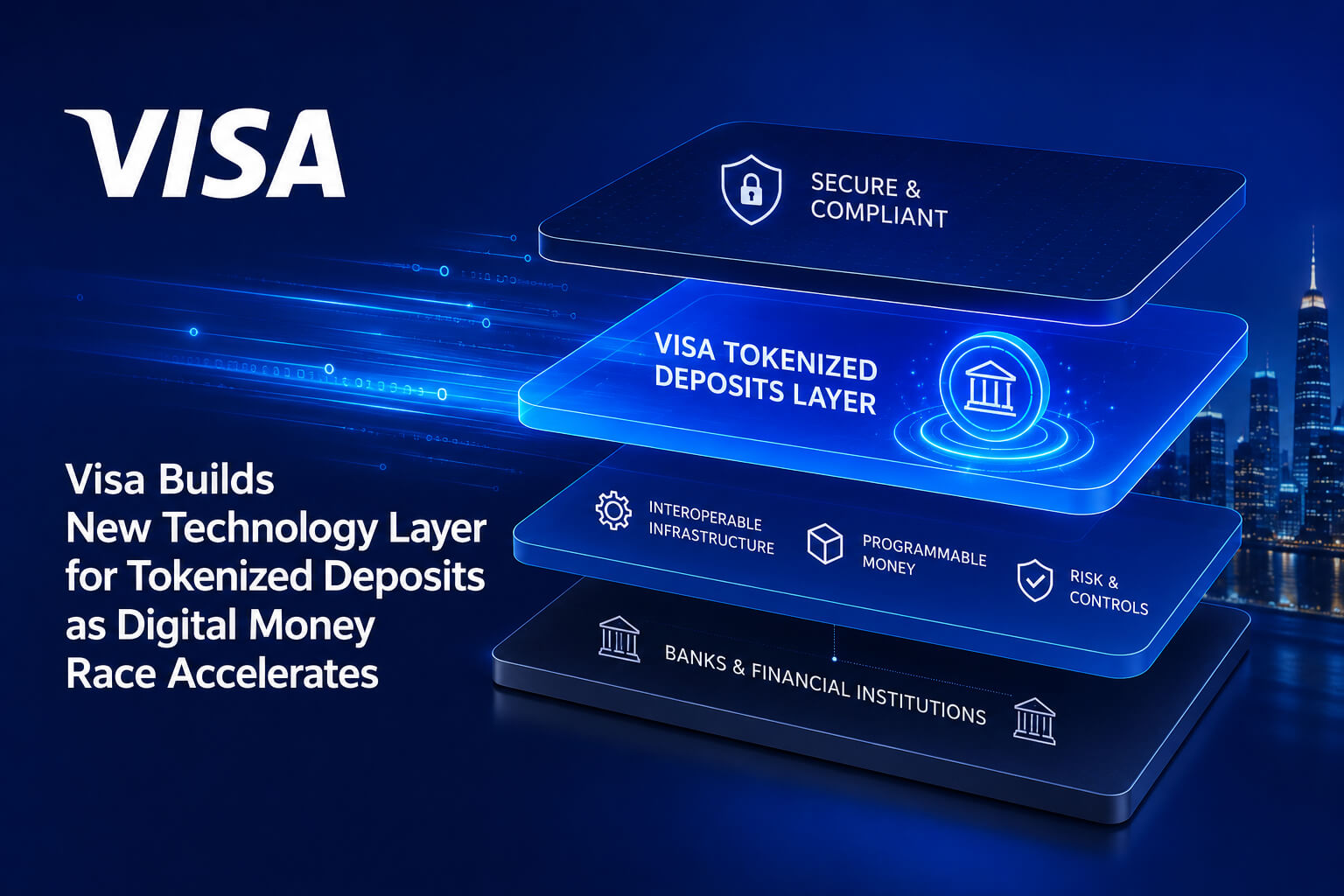
Visa is expanding its role in digital money by developing a technology layer that will allow banks to issue and manage tokenized deposits.
The move highlights the growing competition between traditional financial institutions, stablecoin providers, and blockchain-based payment networks. As stablecoins continue to gain traction for fast, programmable payments, Visa is positioning tokenized bank deposits as another major path for the future of money movement.
Tokenized deposits are digital representations of traditional bank deposits that can move across blockchain-based infrastructure. Unlike many stablecoins, these deposits remain connected to regulated banking systems and stay on a bank’s balance sheet.
Why Visa Tokenized Deposits Matter
The development of Visa tokenized deposits could help banks offer faster, more flexible digital payment services without fully relying on third-party stablecoin issuers.
For banks, this could mean a way to modernize payment infrastructure while maintaining control over deposits, compliance, and customer relationships. For businesses, tokenized deposits could eventually support faster settlement, automated payments, and programmable financial services.
Visa says this approach could give banks the speed and flexibility often associated with stablecoins, while still keeping funds within the traditional banking system.
Banks Look for a Stablecoin Alternative
Stablecoins have become one of the most important innovations in digital payments. They allow value to move quickly across blockchain networks and are increasingly being tested for settlement, cross-border transactions, and merchant payments.
However, banks are also exploring tokenized deposits as a regulated alternative. Because tokenized deposits are issued by banks, they could appeal to financial institutions that want blockchain-based payment capabilities without losing deposit relationships to non-bank stablecoin issuers.
Visa’s new technology layer could help banks bridge that gap.
Visa Expands Its Digital Asset Strategy
Visa’s tokenized deposit work is part of a broader push into digital assets, stablecoins, and next-generation payments.
The company has already been expanding stablecoin settlement pilots across multiple regions, currencies, and blockchain networks. It is also rolling out stablecoin-linked card programs worldwide, showing that Visa sees blockchain-based money movement as a major part of the future payments ecosystem.
By building infrastructure for tokenized deposits, Visa is not choosing between banks and stablecoins. Instead, it is creating tools that could allow both models to exist within its global payment network.
What This Means for Fintech
For fintech companies, Visa tokenized deposits could open new opportunities in payments, embedded finance, treasury management, and programmable banking.
If banks can issue tokenized deposits through trusted infrastructure, fintech platforms may be able to build faster and more automated financial products on top of bank-backed digital money.
Potential use cases include:
Faster business-to-business payments
Real-time settlement
Programmable treasury services
Blockchain-based merchant payments
Cross-border money movement
Digital asset settlement
This could also help traditional banks compete more directly with crypto-native payment companies and stablecoin platforms.
The Bigger Picture: Digital Money Is Becoming Mainstream
Visa’s move shows that tokenized money is no longer just a crypto-sector experiment. Major payment networks, banks, and fintech companies are increasingly building infrastructure for digital value transfer.
Tokenized deposits could become an important middle ground between traditional bank money and blockchain-native stablecoins. They offer the promise of faster digital payments while preserving the structure of regulated banking.
As the fintech industry continues to shift toward real-time, programmable, and always-on financial services, Visa’s tokenized deposit technology could become a key part of the next phase of payment innovation.
Conclusion
Visa’s work on a technology layer for tokenized deposits marks another major step in the evolution of digital payments.
By helping banks bring deposits onto blockchain-based infrastructure, Visa is giving financial institutions a way to compete with stablecoins while keeping funds within the banking system.
For the fintech industry, this development signals a future where bank money, stablecoins, and blockchain infrastructure increasingly work together to power faster and more flexible financial services.