

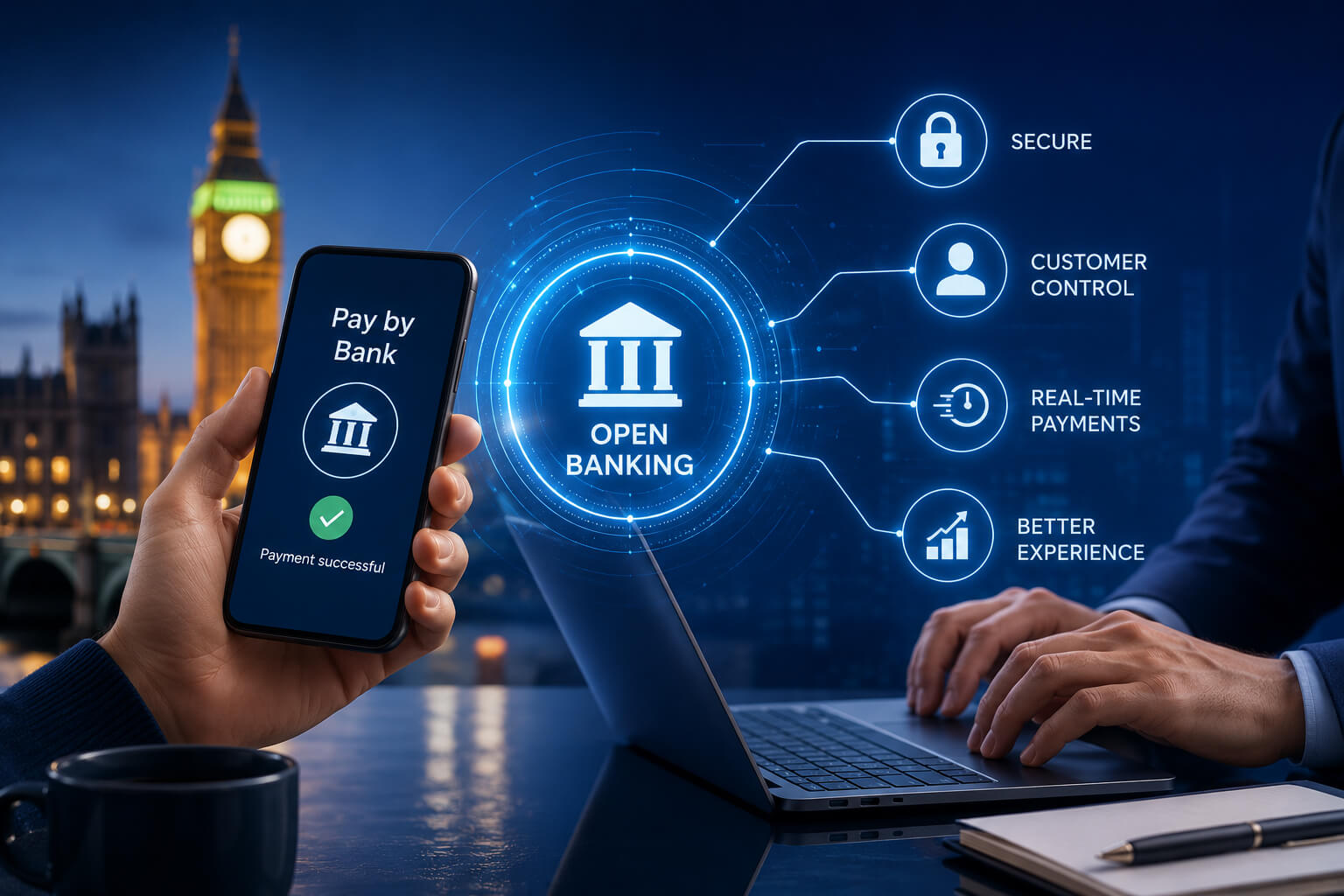
Open Banking and Pay by Bank are quickly becoming major forces in the UK payments industry, changing how consumers pay online and how businesses process transactions.
Pay by Bank allows customers to make direct payments from their bank accounts without using a debit or credit card. Instead of entering card details at checkout, users select their bank, approve the payment through their banking app, and complete the transaction securely.
The payment method is built on Open Banking, a regulated system that allows approved third-party providers to connect with bank accounts when customers give clear consent. This framework has helped create faster, more direct financial services across the UK.
According to the source article, more than 30 million successful Pay by Bank transactions were recorded in January 2026 alone, highlighting how quickly account-to-account payments are gaining momentum. Major brands including Amazon, eBay, Just Eat, Papa John’s, and Ryanair are among the companies now offering or adopting Pay by Bank options.
What Is Open Banking?
Open Banking is a secure financial framework that allows authorised companies to access customer banking data with permission. It was introduced to increase competition in financial services and give consumers more control over their financial information.
Through secure application programming interfaces, or APIs, banks can share approved data with regulated providers. This has enabled a new generation of fintech services, including budgeting apps, faster affordability checks, account aggregation tools, and direct bank payment solutions.
For consumers, Open Banking means more choice and convenience. For businesses, it creates new ways to offer faster, lower-cost, and more secure payment experiences.
How Pay by Bank Works
Pay by Bank is one of the most visible uses of Open Banking.
At checkout, customers choose Pay by Bank as their payment option. They then select their bank and are redirected to their banking app or online banking page. From there, they approve the payment using the bank’s own security process, such as Face ID, fingerprint verification, PIN, or password authentication.
Once approved, the money moves directly from the customer’s bank account to the business. This removes the need to enter or store card details with retailers.
For shoppers, this can make online payments quicker and more secure. For merchants, it reduces reliance on card networks and can lower payment processing costs.
Why Consumers Are Using Pay by Bank
The appeal of Pay by Bank is simple: it is fast, direct, and does not require card details.
Many consumers are already comfortable using mobile banking apps, making Pay by Bank a natural extension of existing digital banking habits. Since authentication happens through the customer’s own bank, users can complete purchases with familiar security tools.
Pay by Bank can also be useful for subscriptions, online services, travel bookings, food delivery, and other regular digital purchases. As more major retailers add the option, consumers are likely to see Pay by Bank appear more often during checkout.
Why Businesses Are Paying Attention
For UK businesses, Open Banking and Pay by Bank offer several important benefits.
One of the biggest advantages is cost reduction. Traditional card payments often involve processing fees, which can become expensive for high-volume businesses. Account-to-account payments can reduce those costs by moving money directly between bank accounts.
Pay by Bank may also help improve cash flow. Card payments can take time to settle, while account-to-account payments are often processed much faster. For businesses managing tight margins or large transaction volumes, faster settlement can be a major advantage.
Another benefit is reduced chargeback risk. Since payments are authorised directly through the customer’s bank, businesses may face fewer disputes compared with some card-based transactions.
Open Banking Goes Beyond Payments
While Pay by Bank is gaining attention, Open Banking supports much more than checkout payments.
One growing area is variable recurring payments. These allow approved providers to collect repeat payments from a customer’s account, while giving users more control over limits and permissions. This could become important for subscriptions, utility bills, financial services, and other recurring payments.
Open Banking also powers account aggregation tools. These apps allow users to view multiple bank accounts in one place, helping them track spending, manage budgets, and better understand their finances.
Lenders are also using Open Banking to improve credit decisions. With customer permission, lenders can review real transaction data rather than relying only on traditional credit scores. This can help create a more accurate picture of affordability, especially for people with limited credit histories.
Major Retailers Could Accelerate Adoption
The involvement of major platforms is helping Pay by Bank move from a niche fintech feature into a mainstream payment option.
Amazon’s adoption of Pay by Bank for UK customers is a strong signal that direct bank payments are becoming more widely accepted. eBay has also moved in this direction through a partnership with Open Banking provider TrueLayer.
As more household names support Pay by Bank, consumer awareness is likely to grow. Once customers become familiar with the process, account-to-account payments could become a normal part of online shopping.
What This Means for the Future of UK Payments
Open Banking and Pay by Bank are part of a broader shift toward faster, more connected financial services.
For consumers, the change means simpler checkouts, fewer stored card details, and more control over payments. For businesses, it means lower costs, faster settlement, and new ways to improve the customer payment experience.
Cards are unlikely to disappear anytime soon, but Pay by Bank is becoming a serious alternative. As adoption grows across retail, travel, food delivery, subscriptions, and digital services, Open Banking could play a much larger role in the future of UK payments.
The rise of Open Banking and Pay by Bank shows how fintech innovation is reshaping everyday transactions — not just for banks and startups, but for consumers and businesses across the UK.